
Ceramic Capacitor Codes
Ceramic Capacitor Codes
How to read a Ceramic capacitor with Numeric coding.
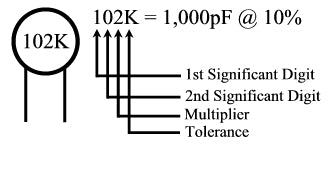
Multiplier Table (Ceramic)
| Number | Multiply By (Additional # of Zeros) |
| 0 | None (0) |
| 1 | 10 (1) |
| 2 | 100 (2) |
| 3 | 1,000 (3) |
| 4 | 10,000 (4) |
| 5 | 100,000 (5) |
| 6 | 1,000,000 (6) |
Common Temperature Coefficient Codes (Ceramic)
| Code | Tolerance |
| C | ±0.25pF |
| J | ±5% |
| K | ±10% |
| M | ±20% |
| D | ±0.5pF |
| Z | +80% / -20% |
Common Temperature Coefficient Characteristics (Ceramic)
| Temperature Coefficient | Operating Temperature Range | Capacitance Change | Minimum Capacitor Tolerance |
| Y5E | -30°C ~ +85°C | ± 4.7% | ±10% |
| Y5F | -30°C ~ +85°C | ±7.5% | ±20% |
| Y5P | -30°C ~ +85°C | ± 10% | ±10% |
| Y5U | -30°C ~ +85°C | +22% / -56% | ±20% |
| Y5V | -30°C ~ +85°C | +22% / -82% | ±20% |
| Z5U | +10°C ~ +85°C | + 22% / -56% | ±20% |
| Z5V | +10°C ~ +85°C | + 22% / -82% | +80% / -20% |
Application Notes (Ceramic):
NPO: Has a very low dissipation factor and are very stable over wide variations in temperature, frequency, voltage, and time. NPO type capacitors are frequently used for precision timing, filtering, frequency setting, and tuning circuits.
X7R: Are used when some capacitance variation is allowed and the dissipation factor is not critical. X7R type capacitors are frequently used for bypass, decoupling, filtering, frequency discrimination, timing, DC voltage blocking, voltage transient suppression, instrumentation, computers, telecommunications, and automotive electronics.
Z5U: Dielectrics have the highest capacitance for their size. Z5U type capacitors have applications in bypass, decoupling, transient suppression, computers, and telecommunications.
Common Capacitor Working Voltages (DC), By Capacitor Type.
| Ceramic | Electrolytic | Tantalum | Mylar (Polyester) | Mylar (Metal Film) |
| 10V | 10V | |||
| 16V | 16V | 16V | ||
| 20V | ||||
| 25V | 25V | 25V | ||
| 35V | 35V | |||
| 50V | 50V | 50V | 50V | |
| 63V | ||||
| 100V | 100V | 100V | ||
| 160V | ||||
| 200V | ||||
| 250V | 250V | |||
| 350V | ||||
| 400V | 400V | |||
| 450V | ||||
| 600V | ||||
| 630V | ||||
| 1000V |